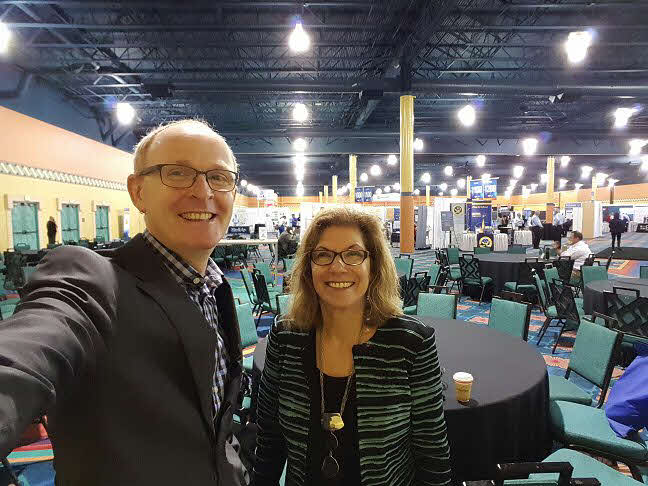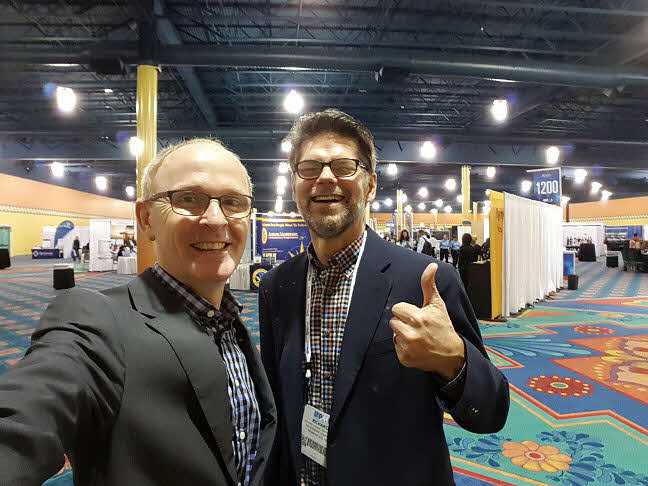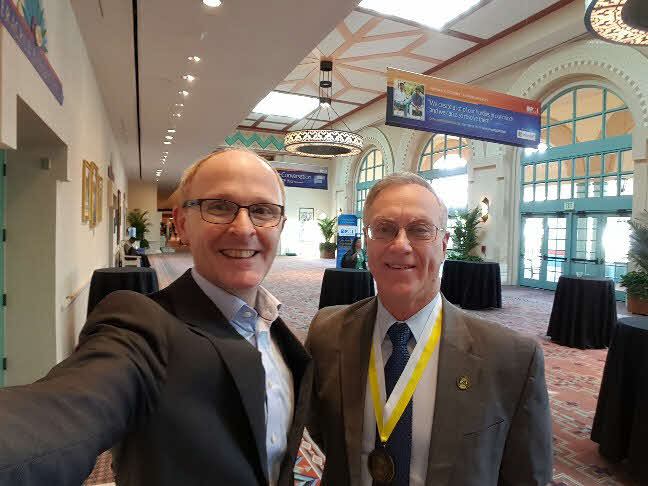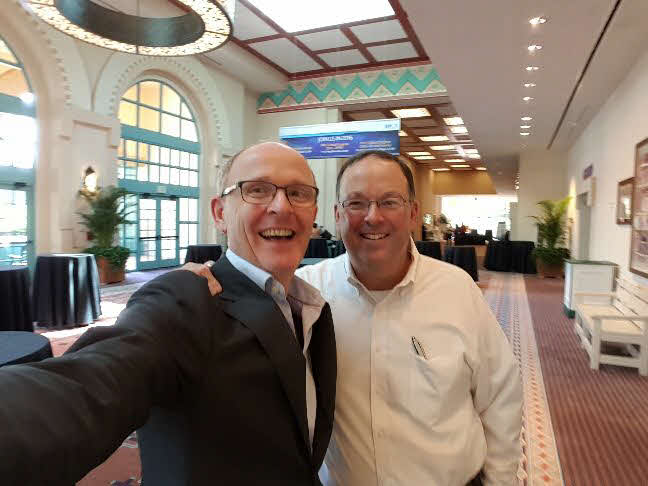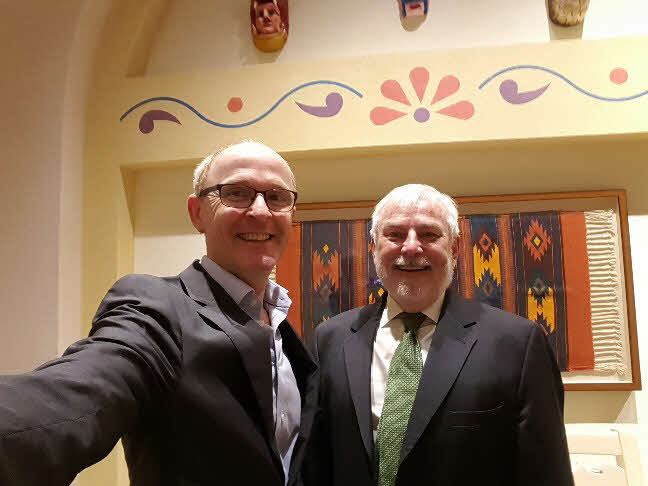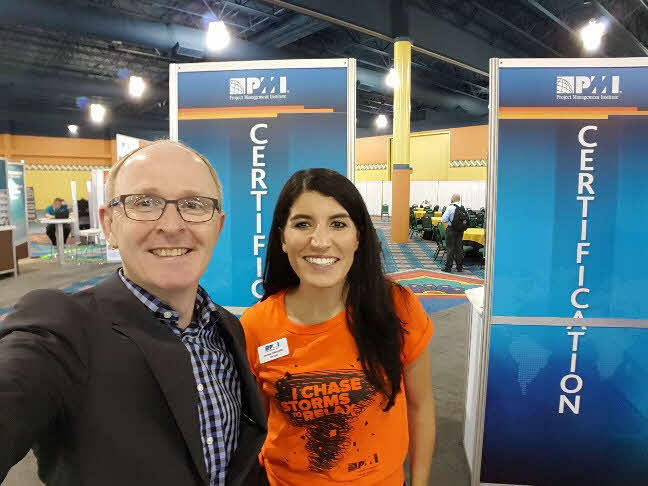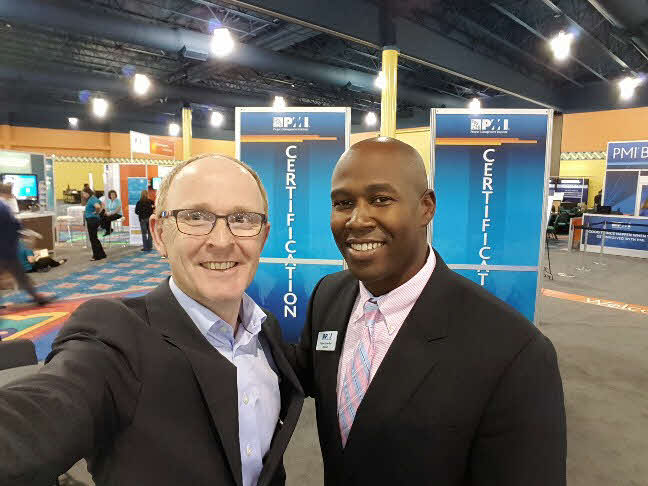


Cornelius Fichtner is presenting "How to Successfully use Social Media and Online Collaboration on Your Projects" at the PMI® Global Congress in Orlando Florida:
How to Attend:
Select this as the session you are going to attend on Tuesday, October 13th 2015, at 8:30am as you make your global congress selections. Then simply show up... :-)
Seminar Description:
This highly interactive presentation examines how social media has affected individuals, organizations and most importantly, projects. You will discover how social media and online collaboration were used on successful projects and the specific lessons learned. You will realize that this is not a passing fad, that it’s the project manager (you!) who must lead the team through the transition, and receive a list of seven action items to apply everything on your own projects tomorrow.
This episode is sponsored by The Agile PrepCast for the PMI-ACP® Exam:
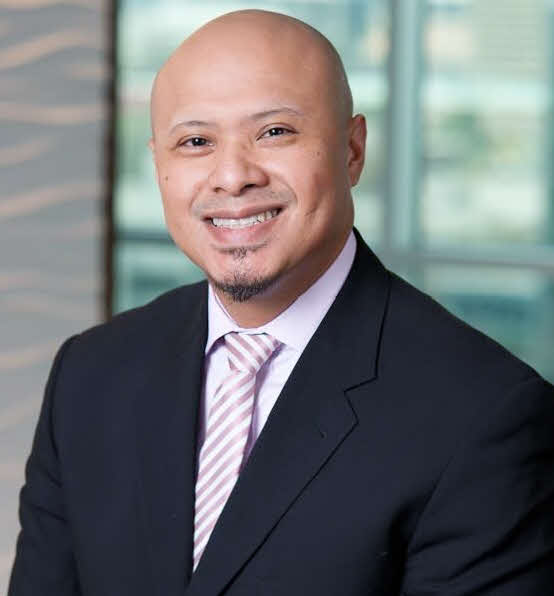
Dr. Emad Rahim, PMP, OMCP
If you are looking to boost your project manager career then you are very likely thinking along the lines of getting a mentor, taking on a stretch assignment, going back to school to get a degree or certification, or maybe even improving your public speaking skills.
But most likely you haven’t thought about accelerating your project manager career path through thought leadership in project management and joining the ranks of famous project managers out there.
And if you think that becoming a thought leader in project management is hard to do, then think again.
Our guest Dr. Emad Rahim, DM, PMP (www.linkedin.com/in/erahim, @DrEmadRahim) assures us that talking about what you love -- project management -- through writing, speaking or simply by finding and sharing pertinent articles will make you get noticed as a thought leader in our industry.
It’s a simple but powerful concept to boost your career in project management.
This episode is sponsored by The Agile PrepCast for the PMI-ACP® Exam:
Todd C. Williams - President and CEO at eCameron, Inc
What is the definition of the project sponsor role?
If you have an executive sponsor on your project and you have a documented and agreed upon project sponsor definition, then you are exceptional.
Why? According to Todd Williams’ (eCameron, Inc) latest white paper titled “Challenges in Executive Project Sponsorship” the lack of project sponsor roles and responsibilities is a major issue. It’s right up there with a lack of engagement, missing change management and the fact that executives don’t even acknowledge that these challenges exist to name just a few.
This executive sponsorship white paper is at the core of our discussion. Todd and I will review the identified challenges and give you the solutions he proposes. You’ll even get his definition of the role of project sponsor.
Here is a time-limited offer for all PM Podcast listeners who would like to read the white paper we discuss:
Download the white paper for free
Todd is making the white paper available for free to listeners of The PM Podcast:
This episode is sponsored by The Agile PrepCast for the PMI-ACP® Exam:
Margaret Meloni - Project Management Coach
When you think of your project manager skills, then “compassion” is probably not the first word that comes to mind. You would probably first list some other hard project management tools and techniques like your scheduling abilities or completing your projects on scope and on budget.
And only if you keep adding words to this project management skills list will you eventually come to terms like conflict management, team building, empathy and compassion.
Margaret Meloni says that we project managers should value compassion much more than we do.
If we are supposed to use compassion as one of our project management soft skills then we have to first define what it is, how it relates to project management and hear examples of how to use it on our projects. And that’s exactly what you are going to get from Margaret’s interview.
But the most important question that I have asked margaret is this: If compassion is truly so important for me as a project manager, how can I see quantifiable results on my projects?
Generally speaking there are six leadership styles: authoritative, democratic, affiliative, pace setting, commanding and coaching. Each one of these has its time and place.
But for you and me as project leaders, project management coaching should be at the top of our list. After all, it is the people working on our projects who get things done, so we want to unlock their potential.
A little while back we had Susanne Madsen on one of our leadership podcasts to discuss how her Project Management Coaching Workbook can help unleash your potential. And today, we are going to do a deep dive into various coaching techniques and how it can make you a better project leader. The tips you'll pick up will help you get better at motivation and coaching skills and working with your colleagues.
This episode is sponsored by The Agile PrepCast for the PMI-ACP® Exam:
Susanne Madsen - Author and Leadership Expert
When we talk about “change management in project management”, the words “resistance” and “tension” often spring to mind.
Consider the resistance to project change management for instance, when two organizations merge, or the fear that employees will feel when a part of their job is automated and some of their skills become redundant.
But the problem isn’t the change itself in spite of the difficulties that it may bring.
To discuss the project change management process with us today I’m very pleased to welcome back one of our favorite interview guests: Susanne Madsen (https://www.susannemadsen.com), whose book The Power of Project Leadership contains a large section on change management.
She says: Organizational change is vital for any business that wants to survive and thrive in our increasingly competitive and fast paced word. The problem is that many project leaders struggle to fully motivate and engage their teams in the process. They often move too fast, are too outcome driven and not sufficiently consultative in their approach.
Good communication is essential for risk management in agile projects so you are sure to pick up some great ideas from this episode -- whether or not you are working in an Agile environment.
This episode is sponsored by The Agile PrepCast for the PMI-ACP® Exam:
Bill Dow, PMP, ITIL, CSM - Author
You don’t necessarily have to manage a social media project in order to recognize the benefits of using the tools of social media project management. Furthermore, being a social media project manager is more than simply publishing a few project updates on Facebook.
In order to really reap the benefits, social media has to be a fully integrated and planned part of your project’s communications management strategy.
Why do project managers need a formal project charter?
What is the role of a program manager?
What are the top 10 pitfalls to avoid when starting a project?
What is the single best way to prevent scope creep?
All answers are detailed, easy to understand and often come with tips and tricks tables and graphics and everything you need to fully understand and implement good practices on your own projects.
This book is also great for anyone preparing for their PMP® Exam. So if you are looking for a good PMP Book then check out the great reviews it has received on Amazon!
This second edition is not just a rehash of what Jeff originally published some years back. Far from it. Jeff revisited every single question and wrote an updated answer to include changes in our industry. So it’s not surprising that he now also includes sections on Agile, Scrum and Stakeholder Management.
This episode is sponsored by The PM PrepCast for The PMP® Exam:
Jeff Furman, PMP - Project Management Coach
Have you ever considered being a project management mentor to another PM in your network? I can tell you from personal experience that while project management coaching sounds like a lot of work the return on investment that you personally get out of it is immense.
And so, when I received an email from Jeff Furman (https://www.linkedin.com/in/jefffurmanlinkedin) and he offered to discuss some of the mentoring approaches that he uses as a project management coach I was all for it.
As you can probably already tell, none of these project management mentoring approaches are rocket science. But we still have some good best practices for you to follow.
Coaching and mentoring is useful for all project managers, but it's especially useful in emerging roles, or where you don't feel that your job description is particularly clear -- the role of project manager in SAFe agile springs to mind as an important position, but perhaps one that is less understood than 'traditional' approaches to being a project manager.
This episode is sponsored by The PM PrepCast for The PMP® Exam:
Bryan Bowers, MBA, PMP
This is another episode in which I am proudly introducing you to one of my successful students who was able to pass the PMP. His name is Bryan Bowers (https://www.linkedin.com/in/bowersbryan) and he is a student of the PMP PrepCast.
There are two reasons that make me especially proud of helping him pass. First of all, Bryan has taken over a dozen certification exams, and second he says that “this was by and far the most brutal exam I have ever taken”. And so I feel very satisfied that it was my exam preparation course that showed Bryan how to prepare for PMP.
In this PMP lessons learned interview you are going to hear him talk about his journey to becoming PMP certified from start to finish.
Do you use an Agile project management approach? And have you maybe noticed a certain fatigue -- an Agile burnout, a Scrum burnout in your team?
Well, Agile is indeed an excellent methodology that is responsive to business changes with quick turnaround and highly visible results. But at the same time, the pace of a project using scrum project management -- or any Agile approch -- is relentless. It never seems to stop and this is potentially one of the biggest agile project management issues that the team may face. Unlike Waterfall there are very few built-in times for team members to catch their collective breath and celebrate milestones. Perhaps project managers in a Waterfall environment would disagree, but I think you can see what I mean.
This Scrum burnout was the basis of the article Agile Fatigue written by Kim Wasson https://www.linkedin.com/in/kimwasson. It’s a relatively short article that contains some good tips on how to combat this effect. So in our interview just now we are going to talk about the following symptoms:
Burnout
Meandering
Stagnation
The daily stand-up turns into a grind
A secret move back to waterfall
But more importantly, we discuss what to do about them in order to battle the burnout, so agile project management with scrum doesn't mean risking your mental or physical wellbeing. Scrum agile project management training is one way of ensuring you are using good practices to manage the process, and in the interview Kim will share more ideas.
When I was a junior project manager, I thought that managing my projects meant for me to focus primarily on the schedule. But as I grew from junior to senior I learned that in order to improve my project manager skills, I needed to learn how to manage project management relationships.
Every project is made up of people, and people are diverse and unpredictable beings. The fascinating study of people, how they interact, and what makes them tick is the heart of project management. It is also at the heart of "People-Centered Project Management", which is a free eBook by Kim Wasson https://www.linkedin.com/in/kimwasson.
The eBook is all about people project management and explores "The five elements that will make or break your project (unless you’re living in a cave)". The five elements are
Building Relationships
Common Goals
Learning Style
Motivation
Skills Matching
These elements are not only at the core of project human resources management, they are also at the center of our discussion. We review each element and and give you lots of tips and tricks so that you can improve your project manager people skills.
This episode focuses on helping project managers enhance their job search by using modern social media tools.
I was asked by PMI Long Island to give a presentation on the topic for their latest Career Event. There were about 25 "in transition" project managers attending the event and my presentation.
This is the recording of this live presentation. It was delivered via WebEx, with me in California and the attendees in Long Island.
Click here to download the PDF handout / checklist that is mentioned during the presentation [Update: The web page is no longer available so we removed the link].
At the end of 2015, the Project Management Institute (PMI) is going to make changes to the way PMI certified project managers have to earn their Professional Development Units (PDUs). And in this episode we are going to explore these changes with John Kleine (https://www.linkedin.com/pub/john-kleine/10/aa1/613), who is PMI’s Global Manager of Certification Products. He is right at the heart of these changes.But before we start let me give you a disclaimer here: If you are not PMI certified and you never intend to become a certified PMP, PgMP®, PMI-ACP®, or any of the other PMI certifications, then stop listening right here. This interview is of no interest to you at all. If on the other hand you are PMI certified, then consider this episode mandatory listening. You need to know this!
First of all you are going to hear that many rules and criteria about PDUs are going to remain the same, and so most of what you know about PDUs today will be true tomorrow. For example, you can still earn Free PMP PDUs by listening to this podcast! But then we are going to delve into the details of the PMI PDU changes by looking at the new PMI Talent Triangle and by going through the current PDU categories and learning what changes are ahead.But before we start let me give you a disclaimer here: If you are not PMI certified and you never intend to become a certified PMP, PgMP, PMI-ACP, or any of the other PMI certifications, then stop listening right here. This interview is of no interest to you at all. If on the other hand you are PMI certified, then consider this episode mandatory listening. You need to know this!
But before we start let me give you a disclaimer here: If you are not PMI certified and you never intend to become a certified PMP, PgMP, PMI-ACP, or any of the other PMI certifications, then stop listening right here. This interview is of no interest to you at all. If on the other hand you are PMI certified, then consider this episode mandatory listening. You need to know this!
Last week, Stephen Wearne introduced us all to the basics of Managing the Urgent and Unexpected. We heard some of the lessons he learned, some best practices and what we can implement in order to prepare our organizations. So from the perspective of a project manager who is put in charge of urgent projects, we have the basics.
But there is of course more to learn by revisiting actual urgent and unexpected projects to see what those projects were like and what kind of takeaways we get from them.
And more than that -- remember that Stephen explained to us that managing an urgent and unexpected project is really the exception. So what I want to know from him at the end is this: What can we learn from all of this in relation to our regular, day-to-day projects.
Have you ever had an urgent or unexpected project come across your desk? Not just an important project, but an urgent one? If you answer is “Yes - I have managed urgent projects” then you are actually in the minority because most of us will actually never have to manage such a project. Professor Stephen Wearne explains this in his book “Managing the Urgent and Unexpected” as follows:
"Urgent and unexpected projects have to be rare in business or government to be economically and socially tolerable. Any such urgent and unexpected work demands an instant start, in contrast to the often lengthy processes of investigation, evaluation, development, selection and planning that is normal normal in businesses and public services before any proposed work is started. The chance that any one person except those in the emergency services will ever manage such a project is small."
Stephen then continues in his book with saying something that I disagree with just a little bit. He says that it’s not possible to know who should learn the lessons learned from these urgent and unexpected projects in order to be prepared. In my opinion, I know exactly who should learn from them -- we project managers should! And that is why I have asked him to come onto the program.
For example, I want to know why Dr Harold Kerzner thinks that it’s the best thing since sliced bread, how it is "better" than traditional methodologies, how it adds value to my work, and of course -- how exactly does Project Workflow Management work?
Well, you are in luck, because Dan Epstein and Rich Maltzman are back to discuss just that.
I also didn’t expect to find a quote by Dr. Harold Kerzner in which he says point blank that project workflow management appears to be the best alternative, and significantly more valuable to us project managers than complex methodologies and processes.
So in today’s interview we will learn about workflow management from various angles - like how it differs from waterfall methodologies and Agile, its primary benefit, the tools it offers, how simple it is to apply, and of course how we project managers can start using this new approach that Dr Kerzner likes so much.
But this time it’s all practical because we are going to discuss and give you the top ten topics, tips and tricks for scope management. And so you can look forward to learning about scope control in project management, the signs that your project needs proper scope management, requirement taxonomies, types of questions to ask during requirements elicitation, requirements prioritization, writing guidelines and many more tips that you can apply to your scope management practices right away.
In my last interview with Jamal we discussed scope in project management, and we are carrying on the topic today because it is such a fundamental part of getting a project set up for success.
Cornelius Fichtner, PMP, CSM, is the host and the author at The Project Management Podcast. He has welcomed hundreds of guests and project management experts to the podcast and has helped over 60,0000 students prepare for their PMP® Exam. He has authored dozens of articles on projectmanagement.com and PM World 360. He speaks at conferences around the world about project management, agile methodology, PMOs, and Project Business. Follow him on Twitter and connect with him on LinkedIn.
Project Management for Beginners and Experts
Going beyond Project Management Professional (PMP)®, PMI Agile Certified Practitioner (PMI-ACP)®, and Certified Associate in Project Management (CAPM)®
PM PrepCast, Agile PrepCast, PM Exam Simulator, PDU Podcast, PM Podcast are marks of OSP International LLC.
PMI, PMBOK, PMP, PgMP, PfMP, CAPM, PMI-SP, PMI-RMP, PMI-ACP, and PMI-PBA are registered marks of the Project Management Institute, Inc.